
Adding beauty
is in our nature.
Adding beauty
is in our nature.
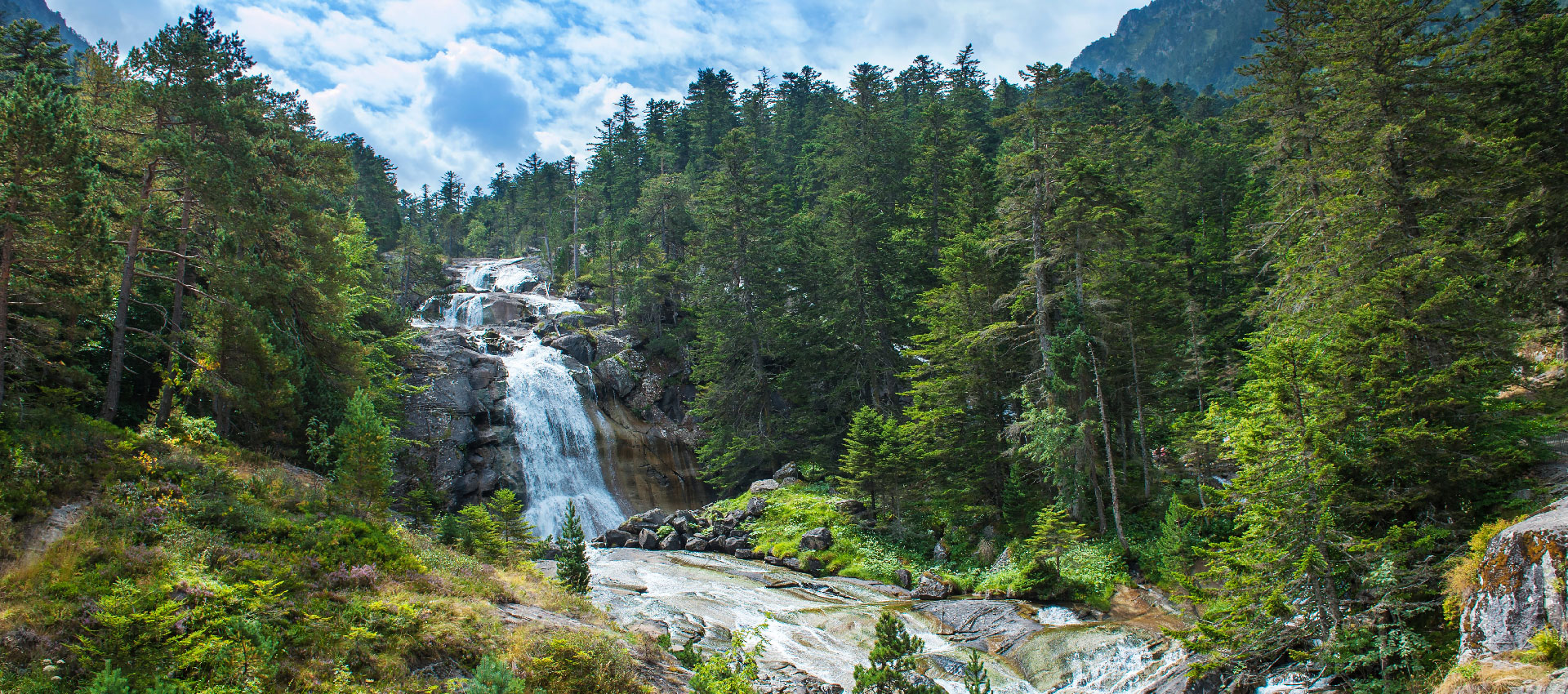
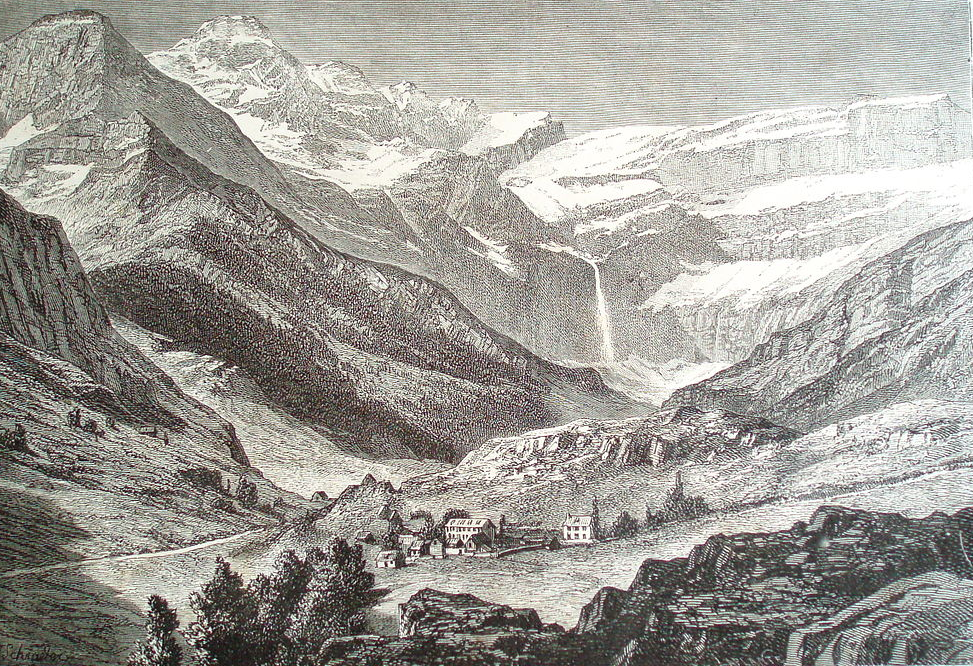 En été 1843, au cours de son “Voyage aux Pyrénées”, Victor Hugo découvre le Cirque de Gavarnie.
Un site qui le marquera à jamais, comme il marquera de nombreux Pyrénéistes, tels Franz Schrader qui signa cette gravure.
Douze ans plus tard, il évoque le souvenir de Gavarnie dans le long poème “Dieu”, terminant ainsi le triptyque commencé avec la Légende des siècles.
In his writing, the circus becomes a gigantic amphitheater, a cosmic battlefield where the voice of the Creation of the World can be heard.
When you have passed the Dourroucats bridge and are only a quarter of an hour from Gèdre, two mountains suddenly move apart and, however concerned you may be about approaching Gavarnie, reveal something unexpected.
Perhaps you have visited the Alps, the Andes, the Cordilleras; for the past few weeks you have had the Pyrenees before your eyes; whatever you may have seen, what you are seeing now is unlike anything you have encountered elsewhere. Up to now you have seen mountains; you have contemplated outcrops of all shapes and heights; you have explored green ridges, slopes of gneiss, marble or schist, precipices, rounded or jagged peaks, glaciers, fir forests mingled with clouds, granite spires, ice needles; but, I repeat, you have seen nowhere what you see at this moment on the horizon.
In the midst of the capricious curves of the mountains bristling with obtuse and acute angles, suddenly appear straight, simple, calm lines, horizontal or vertical, parallel or intersecting at right angles, and combined in such a way that from their whole results the brilliant, real figure, penetrated by azure and sun, of an impossible and extraordinary object.
Is it a mountain? But what mountain has ever presented such rectilinear surfaces, such regular planes, such rigorous parallelisms, such strange symmetries, such a geometric aspect? Is it a wall? Here are towers indeed, buttressing and supporting it, here are battlements, here are the cornices, the architraves, the courses and the stones that the eye can distinguish and almost count, here are two breaches hewn to the quick, which awaken in the mind ideas of sieges, trenches and assaults; but here are also snows, broad bands of snow laid upon these courses, upon these battlements, upon these architraves and upon these towers; we are in the heart of summer and midday; these are therefore eternal snows; now, what wall, what human architecture has ever risen to the terrifying level of eternal snows? Babel, the effort of the entire human race, collapsed upon itself before it had reached its goal.
What is this inexplicable object that cannot be a mountain and yet has the height of mountains, that cannot be a wall and yet has the shape of walls?
It is a mountain and a wall all at once; it is the most mysterious edifice of the most mysterious of architects; it is the colosseum of nature; it is Gavarnie.
Picture this magnificent silhouette as it first appears from a distance of three leagues: a long, dark wall, every projection and crease marked by lines of snow, every platform covered in glaciers. Near the middle, two large towers; one to the east, square and turning one of its corners towards France; the other to the west, fluted as if it were less a tower than a cluster of turrets; both covered in snow. To the right, two deep clefts, the breaches, cut into the wall like two vases filled by clouds; finally, still to the right and at the westernmost point, a kind of enormous rim, pleated with a thousand tiers, which presents to the eye, in monstrous proportions, what in architecture would be called the cross-section of an amphitheater.
Picture it as I saw it: the black wall, the black towers; the brilliant snow, the blue sky; a complete thing at last, grand to the point of being unheard of, serene to the point of being sublime.
This is an impression unlike any other, so singular and so powerful that it erases everything else, and for a few moments, even when this magical vision has disappeared around a bend in the road, one becomes indifferent to everything that is not it.
The surrounding landscape is nonetheless magnificent; you enter a valley where all magnificence and grace envelop you. Two-tiered villages, like Tracy-le-Haut and Tracy-le-Bas, Gèdre-Dessus and Gèdre-Dessous, with their stepped gables and old Templar church, huddle and unfold on the slopes of two mountains, along a mountain stream white with foam, beneath the cheerful and whimsical tufts of charming vegetation. All this is vibrant, delightful, joyful, exquisite; it is Switzerland and the Black Forest suddenly merging with the Pyrenees. A thousand joyful sounds reach you like the voices and words of this gentle landscape: birdsong, children's laughter, the murmur of the stream, the rustling of leaves, the calming breaths of the wind.
You see nothing; you hear nothing; you barely perceive any vague and confused impression of this graceful whole. The apparition of Gavarnie is always before your eyes, and radiates in your thoughts like those supernatural horizons one sometimes sees in the depths of dreams. In the evening, returning from Gavarnie, an admirable moment. From my window: a great mountain fills the earth; a great cloud fills the sky. Between the cloud and the mountain, a thin band of twilight sky, clear, vivid, limpid, and Jupiter sparkling, a golden pebble in a silver stream. Nothing could be more melancholy, more reassuring, or more beautiful than this small point of light between these two blocks of darkness.
Victor Hugo, 1855
"Coffre de pierre immense" qui a vu la Création du Monde ... Victor Hugo avait bien raison ! Il y a 20.000 ans, à cet endroit se tenait un glacier qui descendait de Gavarnie jusqu’à Lourdes. Son énorme masse a creusé la vallée et sculpté la roche, propulsant les terrains calcaires ocres et gris, à plus de 3000 mètres d'altitude.
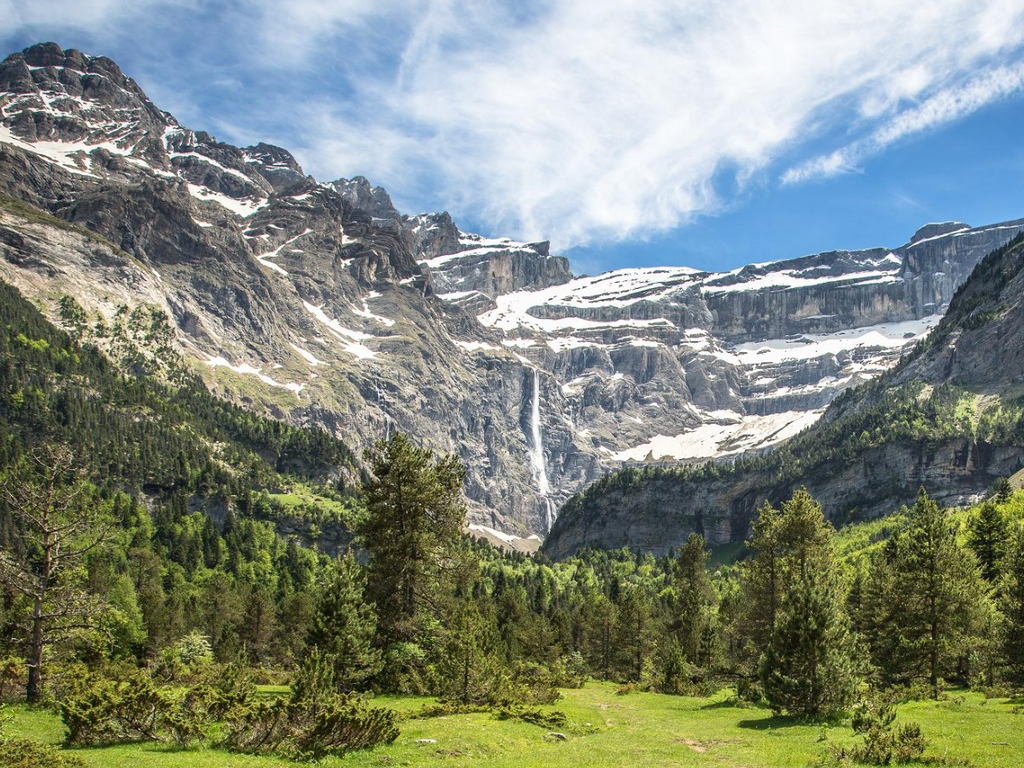
Le cirque est constitué de 16 sommets concentriques, à plus de 3.000 mètres d’altitude : Pic du Taillon (3144 m), Pic du Casque, Pic de l’Epaule, Pic de la Tour, Pic du Marboré (3248 m), du Gabiétou, des Astazous… jusqu’au sublime Mont Perdu (3355 m).
Seule la fameuse “brèche de Roland”, aux multiples légendes, vient briser cette symétrie, offrant un passage vers l'Espagne – le Cirque de Gavarnie marque en effet la frontière entre les Pyrénées françaises, et l’Aragon.
De nombreuses cascades dégringolent des parois abruptes, dont la plus importante, la grande cascade de Gavarnie haute de 422 mètres.
En 1997, le massif du Mont perdu dont fait partie le cirque de Gavarnie a été classé au patrimoine mondial de l’UNESCO au double titre de paysage naturel et culturel - ce site marquant également une longue tradition de pastoralisme entre villages aragonais et français.
Le Cirque de Gavarnie est devenu le point de rencontre des Pyrénéistes - dont certains ont le privilège de reposer face à cette merveille naturelle, au cimetière de Gavarnie - illustrant de la meilleure des manières, l'indissociable expérience physique des montagnes, à l'émotion esthétique et artistique vécue dans les Pyrénées.
Venez visiter cette merveille de la nature, retrouvez le souffle des Pyrénéistes, en séjournant au Chalet La Source !

